thisgivensunday theoutsidecorner crossoverchronicles puckdrunklove crystalballrun runthefloor

NHL lockout looming - Who do you blame?

Written by David Rogers on .

GaryBettman.jpg

If an NHL lockout delays or consumes the 2012-13 season, who should we blame? This was the question I posed on Twitter in an attempt to measure the general pulse of the fans. The sample size was admittedly small but the idea was to get an idea of what the average fan thinks of the impending lockout. 

Would you blame the owners or the players? Would you blame both sides equally? Find out what other fans said and voice your opinion in the comments section. 

The responses I received were all over the place. Some blamed the players, more blamed the owners. A significant number of fans blamed both sides but were quick to point out that they slightly leaned on the owners being more at fault. As you'd expect, I also received a few creative responses which didn't assing blame to either side (more on this later).
OwnersPlayers1.jpg

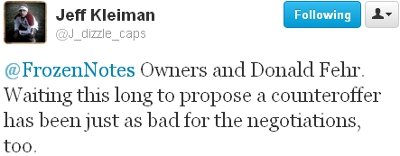
It's maddening that both sides seem to think this negotiating process should be a long one without any sense of urgency. Donald Fehr, executive director of the NHLPA, has been slow in presenting a counteroffer to the league. It's safe to assume this is a negotiation tactic but it is one that is drawing us ever closer to the September 15th date that could begin an NHL lockout in 2012-13. 

Let's make a counteroffer and actually get this ball rolling. Both sides should be working feverishly in getting a new CBA agreed to. Now is not the time to delay. 
OwnersPlayers2.jpg

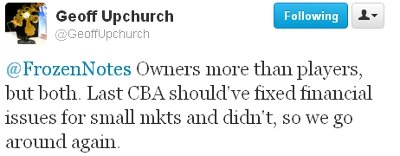
The 2004-05 lockout really wasn't that long ago. The last CBA really should have done a better job of putting us in a better position than we currently are in some eight years later. The 2004-05 agreement was successful in getting hockey back for 2005-06 but it failed to set the league up for success as we currently see in CBA negotiations less than 10 years later. However, that fact aside, you can see that here one fan is blaming the owners more than the players - a common theme found on Twitter. 

OwnersPlayers3.jpg

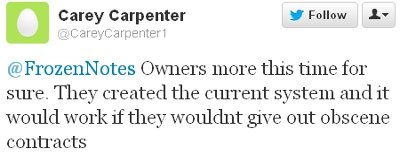
Here another fan blames the owners and mentions that crazy contracts that we have seen handed out in recent months and years have placed the owners at fault. It's frustrating that the owners aren't hesitant to hand out a bloated X-year contract for $100 million or more only to then cry foul and demand to have a larger percentage of the revenue because they are short on cash. Unless I'm mistaken, no one was forcing any of these owners to award players massive contracts.

The owners are responsible to improve their team but they shouldn't have tried to improve based on the idea that they could award hugely flawed contracts only to then demand more money during the CBA negotiations. A player is only worth what someone is willing to pay for him. If the owners as a whole had some sense we wouldn't be facing a situation where two players, Ryan Suter and Zach Parise, could both get nearly $100 million a piece only to later have the owners as a whole say they are broke. 

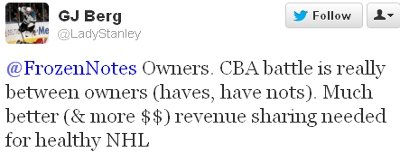
The issue here appears to be more between owners and other owners as opposed to owners versus players.
OwnersPlayers4.jpg

Here one fan points out that the real issue appears to be owners vs. owners and not so much owners vs. players. Certain owners (the haves) have put tremendous pressure on other owners (the have nots). While one owner is in no position financially to hand out a contract any larger than $4 or $5 million a year, another might be in a position to give out multiple contracts worth $8 million or more a year. 

Some teams and owners are genuinely struggling financially and would benefit from additional money under a new CBA. However, some teams are doing perfectly fine as evidenced by the insane contracts we have seen awarded this summer and over the past couple seasons. Where certain teams need help, others do not. The ones that are doing just fine, awarding mammoth deals, have cast the owners as a group under an extremely negative light. 
OwnersPlayers5.jpg

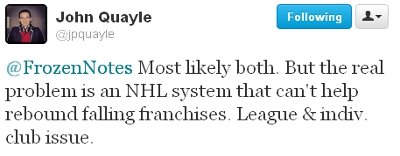
Fellow Puck Drunk Love writer J.P. Quayle voiced his opinion, placing the blame on the current system as opposed to assigning blame to the owners or players. He believes the current system isn't set up to help a franchise that's struggling. He labels it as a league issue and an issue at the club level. 

In my opinion, the NHL needs to focus on coming up with some solutions so that we never have to see a city lose their NHL franchise. The Atlanta Thrashers might be currently excelling as the Winnipeg Jets but the fact remains that the situation should have never been allowed to get to a point where the NHL needs to relocate. That being said, perhaps this issue is one about the NHL being a bit more selective in where they choose to open a new team. Winnipeg is a success currently but we will have to wait and see how that situation unfolds over the coming years. 

OwnersPlayers6.jpg

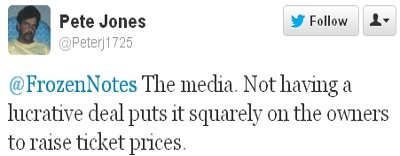
Finally, we'll conclude on one of the most interesting and unique responses I received. This fan places the blame on the media and the current broadcast deal the NHL has. I'm not sure I follow this fan's thinking as the media will only pay X amount of dollars for X amount of viewers. If an NHL game brings in five million viewers you won't find multiple companies trying to bid millions above the estimated value of five million viewers. However, I tend to agree that the media is partially to blame in the NHL's growth as we have seen countless examples of how major media in hockey cities fail to deliver adequate hockey coverage. It's almost a Catch-22 situation - if the NHL was bigger it would require more media coverage. It there was more media coverage the NHL might be bigger. 

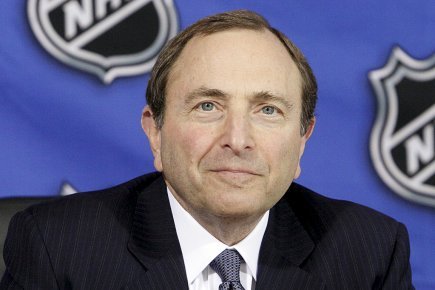
As you can see the responses I received were all over the map. Without getting overly scientific, it's clear that the fans that responded generally blame the owners but also believe that both sides are responsible due to the fact this sort of issue could have been avoided. I did find it interesting that none of the responses I received singled out Gary Bettman, though I imagine that the opinion that the owners are to blame includes Bettman as a representative of the owners. Still, I expected to find a plethora of "Fire Bettman" comments only to find my Twitter feed lacking such a response. 

Which side do you think is to blame? Voice your opinion below. Also be sure to follow me on Twitter (@FrozenNotes) as I'll be running more of these informal polls in the future. 


-----

David Rogers is a staff writer for Puck Drunk Love & runs FrozenNotes.com.

twitter Follow David on Twitter | Email David

facebook Like PDL on Facebook twitter Follow PDL on Twitter | Email PDL


8 comments
Sort: Newest | Oldest
miendiem
miendiem moderator

The more I read about this, the more I think that, once the players offer their proposal, fans of the league from neutral sites should just be called in to arbitrate the damned thing and get it done with.  Not that I particularly had much to begin with, when it came to CBA negotiations, but I find my faith in both the owners and the players waning by the day.

David Rogers
David Rogers

 @miendiem I think it all comes down to how the owners respond to the NHLPA's offer. If there's negotiating or compromising, I'll buy into the idea that a deal will get done before the deadline. If they remain stubborn, I'm calling a lockout a certainty. 

miendiem
miendiem moderator

Okay, let's see if I can hit the post character limit in a non-stats-based post.  heheh


The last time we lost hockey for a year, I'll admit, I wasn't really into it.  Sure, we weren't that far removed from the year my boys took home the President's Trophy, but even then, I really only idly paid attention to hockey, or any other sport.  All of that to say, the last lockout didn't really effect my feelings toward the sport one way or another.  Looking back on it from that view, I can certainly see why it happened, especially as a fan of one of those small-to-mid-market teams, and can easily see why it's likely to happen again. We should probably all be able to agree that the CBA that came out of the last lockout was a step in the right direction, but still flawed enough that it has brought us to the point of suffering another lockout to fix its mistakes. 


The cap floor, and the guarantee of a certain percentage of revenues to the players guaranteed that the players would get paid.  The cap ceiling and revenue sharing (nominally) guaranteed that the big market teams couldn't just buy their way to victory year in and year out.  (We can argue over whether a $16m spread from ceiling to floor really ever guaranteed this, of course.)  Maybe small markets were never meant to be truly competitive in the same way as the New Yorks, Pittsburghs, and Detroits of the hockey world, but they could at least make money (at the start, before the cap floor by the end of the CBA was knocking on what the cap ceiling was at the beginning, just eight years ago) and field a decent product that their fans could enjoy (provided their front office was competent - but there's no way to guarantee any club's fans that in any CBA).


What we wound up with were the loopholes - ways to stay within the technical letter of the current CBA, while abusing it like a speed bag in a boxing gym.  I don't think we need to go a whole lot farther than the twin contracts Minnesota handed out, and the offer sheet to Weber from Philadelphia to see that contracts have gone way off the mark from what the CBA attempted to establish with the salary cap hit rules.  So, naturally, those rules are going to have to change.  Big market teams aren't going to want that, because they're the ones with the financial ability to skirt the system as implemented, and players aren't particularly going to want that, because, let's face it, if it's an option between getting paid early and getting paid late, particularly when you're doing a job that could, on any given day, end your ability to perform it via injury, getting paid early is going to win out almost every time.  Thus, we have the uneasy alliance of the large-market owners and the players' union against the small- and mid-market owners who, at least nominally, should want this to get fixed so that the playing field is actually level.


That dynamic should alter itself when it comes to revenue sharing, however.  The small- and mid-market owners would naturally be all for it, the big market owners against it, and, if they look at it with a critical eye, the players should come to the understanding that properly executed revenue sharing is going to increase their slice of the pie to their advantage (withstanding whatever changes to their % slice of the pie actually end up being in negotiations for the % of hockey related revenue to the players).  The idea would be that the small markets wouldn't eventually get priced right out of the game as the larger market teams revenues expand - which is exactly what's gotten us to the current point.  If anything, though, I almost expect this to become some form of three-way deadlock, with the players not really on anybody's side, because neither of the sets of owners is entirely on their side.  Frankly, again from the perspective of a fan of one of those small-to-mid-market teams, if the NHL can't find a competent way to do revenue sharing, we're eventually going to be looking at contracting teams out of the league, at least with the cap floor/ceiling rules as implemented.  That's primarily why I believe the players should come down on the small/mid market owners side here - whether or not they believe that could actually reasonably happen, and thus do something about it in the negotiations, is obviously beyond my knowledge as an outsider.

David Rogers
David Rogers

 @miendiem It's actually rather impressive how much hockey knowledge you have despite the fact you're relatively new (post-lockout) to the party. Never would have guessed. I had assumed you were a major fan pre-lockout based on some of the analysis you put down. 

miendiem
miendiem moderator

 @David Rogers Well, true and false.  When I was a kid (right around the start of the 90s), Brett Hull was my idol.  I was a HUGE hockey fan, and I remember being massively disappointed when the Blues played on the west coast, because there was no way I could stay up to watch the games.  There weren't all that many televised Blues games back then to begin with, so those few available ones were a prize.  Around the time I graduated high school (which I'll leave blank, but a rough guesstimate can probably be made), I started moving away from sports.  Some of that was probably because I outgrew the age limits for the area leagues, but definitely wasn't grown enough to join the adult leagues - as a byproduct, I started consuming less hockey (and baseball, for that matter).  I still listened to/watched some games here and there, but it was very much a casual interest.  Around that time, my father changed jobs, to one that didn't see us at a game or two a year in the company seats, which certainly had something to do with it as well.


Fast-forward through the lull to the 2010 Winter Olympics.  This is something else that had generally fallen off my radar entirely (and still is - I believe I've caught two matches this entire 2012 Summer Olympics, but that's wholly off-topic), but around the time, I was playing a multiplayer online game with some random folks, including a couple of hockey-mad brothers from Ottawa.  After hearing the gist of, "If you like hockey at all, watch this", I did.  This happened just in time (February) for me to get curious again about the goings-on in the NHL, and to see my boys just barely fail to make the playoffs (90 points, 95 was the Western cutoff that year).  I paid some more attention the near year, though the Blues failed to make the playoffs again, but something had changed along the line, probably back at the Vancouver Olympic ice rink - rather than just my team, though I'm certainly still a Blues homer, I'd become a fan of the game as a whole, and I watched just about as much of the playoffs as I could catch.


So, that's my hockey history in a two paragraph nutshell.  All the rest of this information, financial and what not, I've come to recently, trying to figure out just what went wrong, and what they'll hopefully end up fixing so it doesn't go wrong again.

This comment has been deleted

miendiem
miendiem moderator

Wow, my formatting on that utterly died.  >.>


Percentage of hockey related revenues - We've seen football and basketball peg this at 50% in recent CBAs.  Aside from posturing, there's no reason both sides can't be made to agree on this point.  Unfortunately, we're dealing with people here, and getting them to be reasonable when money is involved is likely a losing proposition.  This, by itself, would be a decent boon to the smaller market clubs, but by itself, it isn't particularly going to do anything to solve the problems of the previous CBA.  While it will be a sticking point in the negotiations, it's not something that I, as a fan, am particularly worried about - if the league and the players can hash out the other issues, this shouldn't be that big of a challenge.


Really, I could go on and on here.  The new proposed contracts rules, for example.  Altering the way the cap floor and ceiling are calculated.  If I were on the players side of the table, getting some actual consistency in officiating and supplemental discipline would be big issues that I would absolutely insist were dealt with to my liking.


So, with all of that said, who do I blame, and why do I blame them?


The owners:  The had a chance not even a full decade ago to get this fixed, and they failed.  They didn't fail mightily, but they failed badly enough that we're doing this dance again, and could wind up losing games, or even another whole season, because of it.


The large-market owners particularly:  Not that I expected them to, but if they could've brought themselves to adhere to the spirit of the current CBA contract rules instead of finding the stretching point of the letter of them, one of the big stumbling blocks of the current talks wouldn't be nearly so much of an issue.  "Let's just fix this so that it can't be abused" would go over a whole lot better with the players if it wasn't an active shot at all the high-dollar, long-term, cap-circumventing deals that culminated in the past off-season.


The small- and mid-market owners particularly:  The league reserves the right to void offered contracts that exist to pull an end-run on the CBA.  To my knowledge, they've used it a grand total of once in the past two years.  This group, which comprises the majority of owners in the league, should have realized what these deals were doing, and killed the lot of them - right up to and including the Philly offer sheet to Weber.  Instead, we now have an issue that splits the owners against each other, to say nothing of having the players involved in the negotiations.


The players:  They have the financials, now they have the absolutely up-to-date financials including the current year.  It should be blatantly obvious to them that roughly two thirds of the league are either financially in trouble now, or will be if the current CBA continues to escalate the problem based on the rising revenues of the top ten teams.  I blame them the least of the lot, if only because they already bent over backwards to try to solve things last time, but the simple fact of the matter is, it's in the players long-term interest for ALL NHL clubs to be on sound financial footing, so they're simply going to have to agree to some of the owners proposed changes, and so far, all they're doing is stalling.  They get bonus negative points for hiring on Donald Fehr to lead them through this round of CBA negotiations, of course.  We'll see just how much more or less we need to blame them when they finally get around to offering their own proposal.

David Rogers
David Rogers like.author.displayName 1 Like

 @miendiem One thing I forgot to add: I side with the players a bit more too because they are strongly trying to do away with the crummy NHL discipline system that has been plaguing the game. That point is one that bothers me so much it almost makes me side with them by default. 

miendiem
miendiem moderator

 @David Rogers As a fan, my heart always says "side with the players", because they're the ones I go to watch.  Then my head says, "if they don't fix the finances, what happens when the Blues go looking for new ownership in another few years?"  Then I extrapolate that into, "And what happens to other teams that are in similar or worse financial straits?"  So, I kind of wind up on this weird side that's part small/mid-market owners, part players, but really, just for the fans.  Of course, the fans aren't represented at the bargaining table, so that's somewhat meaningless.

You Might Like...