
thisgivensunday theoutsidecorner crossoverchronicles puckdrunklove crystalballrun runthefloor

Actions speak louder than words in NHL negotiations

Written by David Rogers on .


The world of PR is a frustrating and sometimes irritating place. The posturing and positioning by the two sides, in this case the players and owners, is continuous while the actual negotiating seems to take a back seat. 

Shortly after cancelling the first two weeks of the 2012-13 season, soundbites emerged from both sides about their take on the situation - desperate moves to ensure positive PR. Save the quotes, owners and players. Your actions speak loud enough. 

Prior to the NHL officially cancelling its first two weeks of the season, fans had been critical about how both sides appeared to be taking a rather lackadaisical approach in negotiating a new CBA. Months passed without the issue ever being seriously addressed. Whether the two sides were procrastinating or just trying to avoid a difficult situation is unclear, but what was clear is that both sides lacked one necessary component - urgency.

Urgency. Dedication to get a deal done. Hard work. 

Unfortunately, none of the descriptive words above describe the negotiating process. Instead, you could use the following: slow, tedious, lazy, uninspired. 

Take for instance the announcement that the NHL was removing two weeks from their schedule. First, consider how odd and yet strangely appropriate that the quotes from the NHL came from the mouth of Bill Daly, NHL deputy commissioner instead of from Gary Bettman. Only in the NHL would the commissioner suddenly go missing when his sport is in a crisis. 

As for the quotes from Daly, this one does a nice job of summing things up. 


Lies. If you were actually committed to getting this done, why weren't you and the opposing side having meetings around the clock in an effort to salvage regular season games? The effort you put in was inexcusable. There was no desperation to prevent a cancelation. Realistically, the two sides should have been meeting continuously for weeks in order to work out a deal. This scenario should not have even been a possibility in the minds of the two sides. 

Meanwhile, player representative Donald Fehr had a few words of his own. 

A lockout should be the last resort in bargaining, not the strategy of first resort. For nearly 20 years, the owners have elected to lock-out the players in an effort to secure massive concessions. Nevertheless, the players remain committed to playing hockey while the parties work to reach a deal that is fair for both sides. We hope we will soon have a willing negotiating partner.

Fehr's quotes sound good, don't they? Unfortunately, they also ring hollow because Fehr's side has been just as lazy about this situation. They've done a great job in the PR department but they also have been slow to respond and uninspired to actually make progress where it counts. The players are clearly committed to playing hockey*.

*Abroad, while negotiations sit nearly completely idle.

Actions speak louder than words. Both sides can continue to churn out the quotes but until a deal is reached, save the talking. No hockey fan cares what you have to say until the words "We've reached a deal" escape your lips. Even then, don't expect hockey fans to welcome you back with open arms. When the season returns the entire process needs an overhaul, including the staff involved, in order to prevent yet another lockout in the coming years.

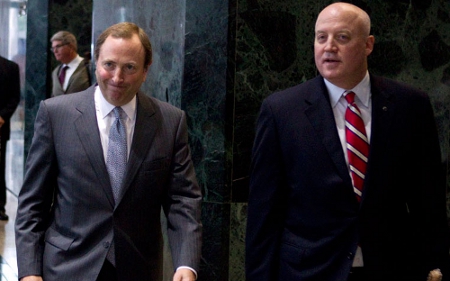
Photo courtesy of the Canadian Press


-----

David Rogers is a staff writer for Puck Drunk Love & runs FrozenNotes.com.

twitter Follow David on Twitter | Email David

facebook Like PDL on Facebook twitter Follow PDL on Twitter | Email PDL


7 comments
GeoffUpchurch
GeoffUpchurch

@FrozenNotes Replied to, loudly and lengthily.

FrozenNotes
FrozenNotes

@geoffupchurch I'd expect nothing less!

GeoffUpchurch
GeoffUpchurch

@FrozenNotes Apparently there's at least one columnist who agrees with us: http://t.co/YBuFZuOu

FrozenNotes
FrozenNotes

@geoffupchurch Great article by @garylawless on the spin. Summed up my opinions nicely.

miendiem
miendiem moderator

There's been a lot of foot-dragging from the players' side - when they wanted to start, taking a month to make a first counter-proposal, so on and so forth.  Of course, there's been plenty of foot-dragging by the owners' side, too.  If all that time the players took after the owners original proposal was on numbers issues (and that's what we've been lead to believe by the players reps), why didn't the owners insist on talks in the interim on non-economic issues?  Really, there is an impressive amount of blame to go around here.


First off, both sides are damaging the image of the league, and by extension, the game.  The NHL is supposed to be the highest level of hockey played in the world - instead, we wind up with players flung the world over showcasing their talents in multiple different, lesser leagues.  The league comes out of it looking incredibly weak and, this being the second time in eight years, more of a punchline than a serious professional sports enterprise.


Second, that record $3.3B in revenue last season?  Let's step back a minute from that, and think:  Certainly both the players and the owners are expecting the fans to return, and why wouldn't they?  By and large we did, last time.  Of course, it took pretty much until the 2010 Winter Olympics to recapture that, and start bringing the more casual fans back into the fold.  Do the two sides really want to wait until Sochi in 2014 and hope that the competition there will be compelling enough to start drawing casual entertainment dollars back to their sport?  Because I don't think it's a stretch at all to guarantee that quite a bit of the gap between the re-opened 2006 league's 2B and last year's 3.3B was due mostly to casual hockey fans, who won't have any trouble finding other things to spend that money on.  Long story short:  Hope the league enjoyed those record revenues - I doubt they're going to reach that number again any time soon if this drags on much longer.


Third, meanwhile, the KHL and ESPN are busy trying to sucker punch the league while it's down.  It makes plenty of business sense, and as a fan of the game, I applaud them for it.  Sure, it doesn't have the same lustre as the NHL, but they've got a good handful of the league's stars, and some of the interesting potential prospects, too.  This may end up being the hard-core fan's fix in the interim, and while it's likely not in the cards that they'll wind up spending on tickets to attend, the merchandising options are obviously there.  Devils fans getting Kovalchuk SKA jerseys?  Why not?  A jersey collector might enjoy the novelty of it.


Fourth and finally, back to the league, and money.  There's roughly enough revenue from the teams in the black at the moment to revenue share to the teams losing money at a $4M/team clip, if revenue sharing were made available to all teams losing money, regardless of market size.  The numbers I've read indicate that the Blues are actually receiving more than that right now, just to use the team I'm familiar with as an example.  Plus, reports say they lost $20M last season, inclusive of that larger chunk, even though they barely cracked the cap floor.  So, while improved revenue sharing in some manner would likely be good for the overall health of the league, the bottom line is that the players are simply going to have to compromise on lowering their percentage.  The alternative is to seriously consider and eventually contract the bottom several teams revenue-wise from the league, so that the new bottom is closer to breaking even, and small enough that revenue sharing can keep them afloat.  Either that, or the cap will have to be lowered significantly so that teams with lesser revenues can still compete and not bleed cash, while allowing the large-market clubs to continue to print a bit more money.  Functionally, though, that's essentially the same thing to the players, when it comes to lowering their slice of the pie.


Frankly, there's no way that the owners and players don't see this.  All they're doing by being intentionally blind to it is harming their current earnings, harming the health of the league, harming whatever goodwill they haven't already expended with the fans that was built up since the last lockout, and ensuring that they'll be making less money when they finally do come around and hammer out an agreement.

David Rogers
David Rogers

 @miendiem Great response, as always.


What's truly amazing to me is here we have the NHL, a league with revenue over $3 billion, in this odd area prior to total collapse. If you asked a random sampling of people which league, and I mean strictly league not sport, might vanish within five years the consensus would have to be the NHL. That's just so crazy to me that there might be a time where the NHL ceases to exist and something else springs up. It'd be crazy, yet not surprising given how we've seen the NHL continually inflect self harm.

miendiem
miendiem moderator

 @David Rogers I could see a situation where the league folds.  I do find the situation I described above more likely, though - contraction of several financially failing teams.  Mostly, I think this only because of how much history the league has under the NHL banner.  Without that, while it would be tough to quantify the damage it would do in advance, I expect the fallout would be quite harmful.


Of course, if the league loses the year this time, and league-wide revenues collapse (which I expect they would), maybe taking that additional hit to re-form the league would be worth it in the eyes of the folks making the decision.

You Might Like...